Startup Hosting Costs: What a Rails App Really Costs per Month, Line by Line

Startup hosting costs for a typical Rails app run from about $12–45 a month at MVP stage to $125–200 a month once the product has launched and needs redundancy, background workers, a production-grade database, Redis and a staging environment. Those are list prices on Heroku, Render and Fly.io in October 2026. The compute line is rarely what surprises founders. The surprises are the database tier you’re forced into, the per-environment duplication, workspace fees, and the engineering hours spent operating it all. This guide breaks the bill down line by line, compares platforms at two stages, and shows where the money can be saved without risking uptime.
TL;DR
- An MVP (one web instance and a small database) costs $12–13/month on Heroku or Render, and about $45/month on Fly.io with Managed Postgres, which includes high availability.
- A launched product (two web instances, a worker, a production database, Redis and staging) costs about $124/month on Render, $163 on Fly.io and $202 on Heroku at list prices.
- The database is the line item that jumps most between stages: $5–6/month for a starter plan, $19–75/month for something you’d trust with paying customers.
- Staging, preview environments and workspace fees add 20–40% to the bill. They’re easy to forget and easy to trim.
- The biggest hosting cost for a small team is engineering time. A platform that saves one day of ops work a month is worth more than any per-instance price difference.
Table of Contents
- How much does hosting cost for a startup?
- What goes into a startup hosting bill?
- Stage 1: What does an MVP cost to host?
- Stage 2: What does a launched product cost to host?
- The costs nobody budgets for
- How Heroku, Render, Fly.io, Upsun and Enkihost price hosting
- How to reduce startup hosting costs without risking uptime
- Which hosting setup should a startup choose?
- Author Perspective: budget for the second year
- Enkihost for early-stage Rails startups
- FAQ
- Sources
How much does hosting cost for a startup?
For a Rails startup, expect roughly $10–50 a month while you’re validating an idea and $120–250 a month once real customers depend on the product. The range depends far more on the database plan and the number of environments than on the web servers.
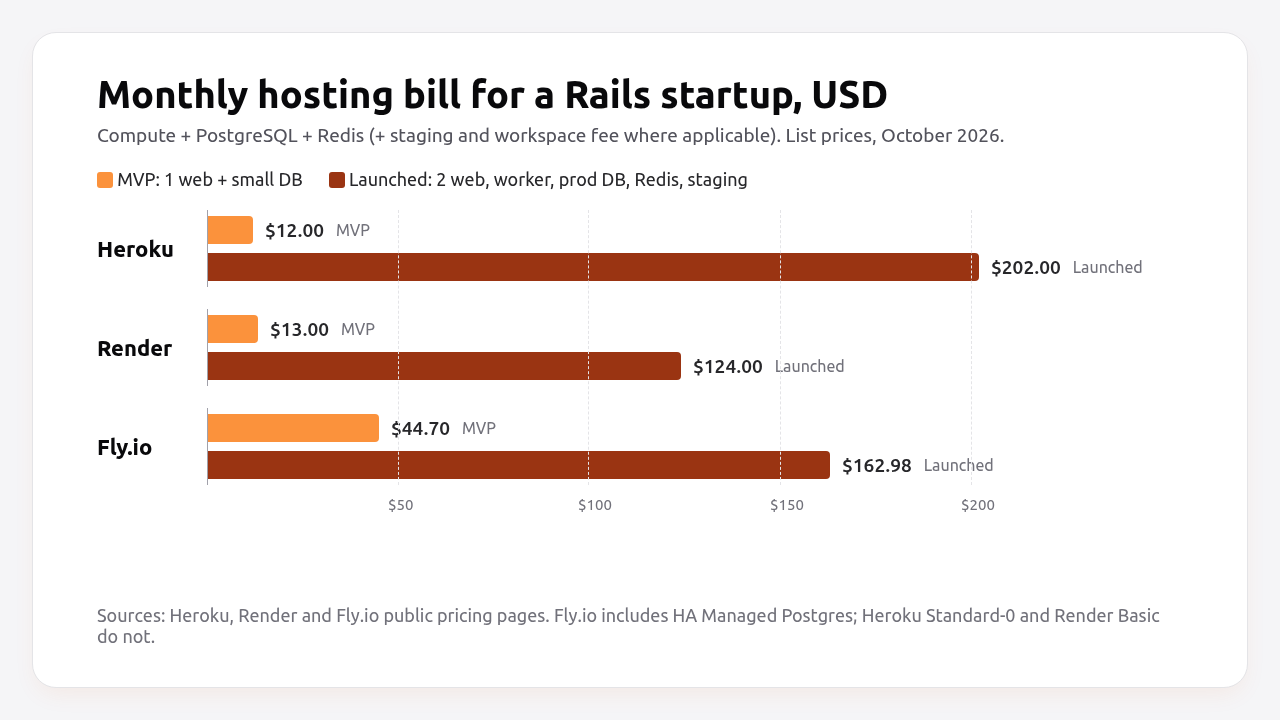
| Platform | MVP / month | Launched / month |
|---|---|---|
| Heroku | $12.00 | $202.00 |
| Render | $13.00 | $124.00 |
| Fly.io | $44.70 | $162.98 |
List prices from each provider’s public pricing page in October 2026, compute + database + Redis + staging + workspace fee, excluding bandwidth and third-party services. Line items below.
These numbers aren’t “cheapest possible”. They’re what a sensible, production-minded setup costs on each platform with its own managed services. You can go lower by self-hosting PostgreSQL or skipping staging, and the trade-offs of that are covered below.
What goes into a startup hosting bill?
A startup hosting bill has six recurring parts. Only the first is what people usually mean by “hosting”.
| Line item | What it is | Typical range | Scales with |
|---|---|---|---|
| Web compute | Instances running Puma | $7–50 per instance | Traffic, redundancy |
| Worker compute | Instances running Sidekiq/Solid Queue | $7–25 per instance | Job volume |
| Database | Managed PostgreSQL | $5–75+ | Data size, connections, HA |
| Cache / queue store | Managed Redis/Valkey | $3–15 | Memory |
| Environments | Staging, review apps | +20–40% of production | Team habits |
| Platform fees | Workspace/seat plans, add-on minimums | $0–25+ | Team size |
| Bandwidth & storage | Egress, object storage, backups | Usually small early | Users, uploads |
| Third-party services | Email, error tracking, uptime checks | $0–50 | Usage tiers |
Two structural points:
- Every environment duplicates the stack. A staging app needs its own web instance and its own database. A review app per pull request multiplies that again.
- Managed databases are priced in tiers, not linearly. On Heroku, the jump from Essential-2 ($20, shared) to Standard-0 ($50, dedicated, 200 connections) is where many apps land once they have paying users.
Stage 1: What does an MVP cost to host?
An MVP needs one web instance and a small database. Background jobs can run inside Puma, and the cache can live in the database with Solid Cache, so there’s nothing else to pay for.
| Heroku | Render | Fly.io | |
|---|---|---|---|
| Web | Basic dyno, 512 MB: $7 | Starter, 512 MB: $7 | shared-cpu-1x, 1 GB: $6.70 |
| PostgreSQL | Essential-0, 1 GB storage: $5 | Basic-256mb, 1 GB storage: $6 | Managed Postgres Basic, 1 GB RAM, HA: $38 |
| Workspace | — | Hobby: $0 | — |
| Total | $12.00 | $13.00 | $44.70 |
Fly.io looks expensive here only because its smallest managed database includes high availability, backups and connection pooling, which the $5–6 plans elsewhere don’t. You can run PostgreSQL on a Fly Machine yourself for a few dollars, but then backups and failover are your problem.
What an MVP setup deliberately leaves out:
- A second web instance. Deploys and crashes cause brief downtime, which is acceptable while you’re validating.
- Redis. Rails 8’s Solid Queue, Solid Cache and Solid Cable run on PostgreSQL. See Rails background jobs in production for running Solid Queue inside Puma.
- Staging. Test on your machine, ship small changes, keep a rollback ready.
Pro Tip: Check what a starter database plan actually limits. Heroku’s Essential-0 caps storage at 1 GB and shares the server, so it’s fine for an MVP but not for a launch. Small connection limits are covered in the connection pool guide.
Stage 2: What does a launched product cost to host?
A launched product needs redundancy and separation: two web instances so a deploy or crash doesn’t take you offline, a dedicated worker, a database plan meant for production, Redis if you use Sidekiq, and a staging environment.
| Heroku | Render | Fly.io | |
|---|---|---|---|
| Web ×2 | Standard-2X (1 GB) ×2: $100 | Standard (2 GB) ×2: $50 | shared-cpu-1x (2 GB) ×2: $26.78 |
| Worker | Standard-1X: $25 | Starter worker: $7 | shared-cpu-1x (1 GB): $6.70 |
| PostgreSQL | Standard-0 (64 GB, 200 conn.): $50 | Basic-1gb (10 GB incl.): $19 | MPG Starter (2 GB, HA) + 10 GB: $74.80 |
| Redis | Premium-0: $15 | Key Value Starter: $10 | Upstash fixed 250 MB: $10 |
| Staging | Basic + Essential-0: $12 | Starter + Basic-256mb: $13 | 1 GB machine + MPG Basic: $44.70 |
| Workspace | — | Pro: $25 | — |
| Total | $202.00 | $124.00 | $162.98 |
These aren’t like-for-like, and the differences matter more than the totals:
- Memory per web instance ranges from 1 GB (Heroku Standard-2X) to 2 GB (Render Standard, Fly.io 2 GB). More RAM means more Puma workers, so the Heroku setup has noticeably less capacity for its price.
- Database resilience differs. Fly.io’s Managed Postgres includes HA. Heroku Standard-0 and Render Basic don’t. Heroku’s HA starts at Premium-0 ($200).
- Autoscaling isn’t included at these tiers on Heroku, where it requires Performance dynos at $250+ each. We covered scaling costs in how to scale a Rails app.
The costs nobody budgets for
The line items above are predictable. These are the ones that turn a $120 estimate into a $300 invoice:
- Preview environments. One review app per open pull request, each with its own database. Five open PRs on Render at Starter + Basic-256mb is another $65/month.
- Idle staging. A staging stack that runs 24/7 but is used two hours a week. Scale it to zero or delete and recreate it.
- Database storage overage. Render charges $0.30/GB and Fly.io $0.28/GB beyond the included storage. Logs or analytics tables kept in PostgreSQL grow this quietly.
- Bandwidth. Usually small early, but serving images and downloads from the app instead of a CDN or object storage adds up. Render, for example, bills bandwidth beyond the included allowance.
- Third-party services. Transactional email, error tracking, uptime monitoring, log retention. Most have free tiers that run out right around launch.
- Engineering time. The largest cost and the one that never appears on an invoice. If someone on a three-person team spends one day a month on servers, patches, backups and failed deploys, that costs more than every line above combined.
Pro Tip: Put a monthly calendar reminder on the first of the month to open every provider’s billing page. Most surprise bills are visible in the first week, when they’re still cheap to fix.
How Heroku, Render, Fly.io, Upsun and Enkihost price hosting
The five platforms use different pricing models, and the model affects your bill more than the headline price.
| Platform | Pricing model | Free / entry tier | What drives cost up | Billing granularity |
|---|---|---|---|---|
| Heroku | Fixed price per dyno and add-on plan | Eco $5 (sleeps), Basic $7 | Dyno tier jumps (Standard → Performance), Postgres tiers | Per second, capped at the monthly price |
| Render | Workspace plan + per-service instance + metered extras | Hobby workspace $0; free instances spin down | Workspace fee, instance size, storage and bandwidth overage | Per second, prorated |
| Fly.io | Usage-based per Machine, volume and add-on | Small machines from about $2/month | Running machines 24/7, managed Postgres plans | Per second while running |
| Upsun | Resource-based (CPU, RAM, disk per container) per project | Trial | Number of environments and containers | Per resource-hour |
| Enkihost | Fixed monthly plan, PostgreSQL and Redis included | Ignite 9 EUR after a 14-day trial; Spark 0 EUR is Jekyll-only | Moving to Blaze (29 EUR) for more apps, dedicated vCPUs and HA | Monthly plan, no listed surcharges |
What that means in practice:
- Heroku is the most predictable and the most expensive per GB of RAM. Good for teams who value simplicity and are willing to pay for it.
- Render is cheaper per GB, but the workspace fee and metered extras make the bill less predictable as the team grows.
- Fly.io rewards apps that can stop machines when idle and punishes “always on everything”. Its managed database is priced as a production product from the start.
- Upsun bills by resources per environment, so the number of environments, including staging and preview environments, is the main cost lever.
- Enkihost is the most predictable: one plan price with PostgreSQL and Redis included and no listed surcharges. The limits are the plan’s: 2 GB of shared RAM and a 5 GB database on Ignite, and no separate worker processes on any plan.
Our earlier true cost of Ruby hosting comparison looked at the specific price of zero-downtime deploys. The same pattern shows up here: redundancy is where entry-level prices stop being entry-level.
How to reduce startup hosting costs without risking uptime
Cut the costs that don’t protect customers. Keep the ones that do.
| Saving | Typical monthly saving | Risk | Do it? |
|---|---|---|---|
| Run Solid Queue inside Puma instead of a separate worker | $7–25 | Heavy jobs slow down pages | Yes, until jobs get heavy |
| Use Solid Cache instead of a Redis add-on | $10–15 | Slightly slower cache reads | Yes, for most apps |
| Scale staging to zero outside working hours | 50–70% of staging cost | None | Yes |
| Limit review apps to PRs with a label | Varies, often $30+ | None | Yes |
| Serve uploads and assets through object storage + CDN | Bandwidth and instance size | None | Yes |
| Self-host PostgreSQL on a VM | $15–70 | Backups, upgrades and failover become your job | Only with real ops experience |
| Drop to one web instance | 50% of web cost | Downtime during deploys and crashes | Only if your platform does zero-downtime deploys on one instance |
| Pick a smaller database plan than you need | $20–40 | Connection limits, no HA, storage caps | No |
The pattern: everything that removes a service (Redis, a separate worker, an idle staging stack) is a safe saving early on, because Rails 8 can do that work with PostgreSQL. Everything that weakens the database is a false saving.
Which hosting setup should a startup choose?
Choose by stage and by how much operations work your team can absorb.
| Situation | Recommendation |
|---|---|
| Pre-launch, solo founder | One web instance + starter PostgreSQL, Solid Queue in Puma, no staging. Budget $0–15/month. |
| Launched, first paying customers | Zero-downtime deploys, a production database plan, a worker once jobs get heavy, staging that scales to zero. Budget $50–150/month. |
| Growing team, uptime commitments | Two or more web instances, HA database, separate Redis for Sidekiq, monitoring and alerting. Budget $200–500/month. |
| Team with ops experience, cost-sensitive | Kamal on rented servers with a managed database. Lowest bill, highest time cost. |
Author Perspective: budget for the second year
The first year’s hosting bill almost never hurts. What hurts is the second year, when the app has customers, staging has become three environments, the database has outgrown its plan and nobody remembers why there are two Redis add-ons. My rule for founders: write down the hosting bill you expect at 10× your current users, on the platform you’re on now. If that number makes you uncomfortable, it’s much easier to change platforms or architecture now, with one app and no customers waiting, than in a year. And count your own hours. They’re the most expensive resource you’re spending.
Enkihost for early-stage Rails startups
Most of the cost in the tables above comes from stacking separately billed pieces: instances, database tiers, Redis, workspace fees, and redundancy just to get deploys without downtime. Enkihost is built for the stage where a Rails startup needs to look production-grade without paying production-tier prices for every piece:
- Clear plans: Ignite at 9 EUR per month after a 14-day free trial, with PostgreSQL and Redis included, and Blaze at 29 EUR with high availability and autoscaling. The free Spark plan is for Jekyll sites.
- Zero-downtime deploys without having to run and pay for a second instance just to avoid dropped requests during a release.
- PostgreSQL and Redis add-ons that inject
DATABASE_URLandREDIS_URL, so Solid Queue, Solid Cache or Sidekiq work without manual wiring. - Allocated memory and CPU per app with per-app resource isolation, so the budget you planned for is the capacity you get.
See enkihost.com.
FAQ
How much should a startup spend on hosting?
Early-stage startups typically spend between 10 and 50 dollars a month before launch and 100 to 250 dollars a month after launch for a single Rails app with a database, a worker, Redis and staging. If hosting is more than a few percent of your monthly revenue at that stage, something is oversized or duplicated.
Is Heroku too expensive for startups?
Heroku is predictable and simple but costs more per gigabyte of RAM than Render or Fly.io, and features like autoscaling and high-availability databases sit in higher tiers. For a small team that values its time over the monthly bill, it can still be a reasonable choice. For cost-sensitive startups, the gap grows quickly after launch.
Do I need a staging environment from day one?
No. Before launch, testing locally and deploying small changes is usually enough. Add staging when you have paying customers or more than one developer, and make it scale to zero or be recreated on demand so it doesn’t cost as much as production.
Is it cheaper to self-host on a VPS?
The server itself is cheaper, often 5 to 20 euros a month for resources that would cost much more on a PaaS. But you take on backups, security updates, database upgrades, monitoring and failover. It pays off only if someone on the team already has that experience and the time to use it.
What is the most expensive part of hosting a Rails app?
For most startups it is the managed database once you need a production-grade plan, followed by running duplicate environments. Over a year, the engineering time spent operating the infrastructure usually exceeds both.
Sources
- Heroku pricing and dyno types — Heroku
- Heroku Postgres plans — Heroku Elements
- Heroku Key-Value Store — Heroku Dev Center
- Render pricing — Render
- Render Key Value — Render Docs
- Fly.io resource pricing — Fly Docs
- Fly.io Managed Postgres plans — Fly Docs
- Upstash for Redis on Fly.io — Fly Docs
- Upsun pricing — Upsun